- The Discount Newsletter
- Posts
- What Happened to America?
What Happened to America?
We took pride in buying products that were made on U.S. soil

The Discount Newsletter
July 09, 2023

Welcome to The Discount 💰 Dive deep into financial markets with us every week.
“Made in America” was a source of pride. It was synonymous with quality… and good, high-paying jobs.
Then, globalization happened.
American factories shut down. Jobs went overseas. Entire towns crumbled.
But it’s not all bad news.
A new U.S. manufacturing renaissance is underway… and the investment implications of it are massive.
We’ll get to what those are in a second.
But we want to first welcome you to The Discount Weekly. Each week, we look at the biggest issues facing traders and investors… and explain how they impact your portfolios.
Today, we’re doing a deep dive on “reshoring.”
Reshoring, in a nutshell, is all about bringing manufacturing home. It’s the opposite of offshoring. .
Over the past few years, interest in reshoring has skyrocketed. It’s one of the hottest topics of conversations on corporate earnings calls.
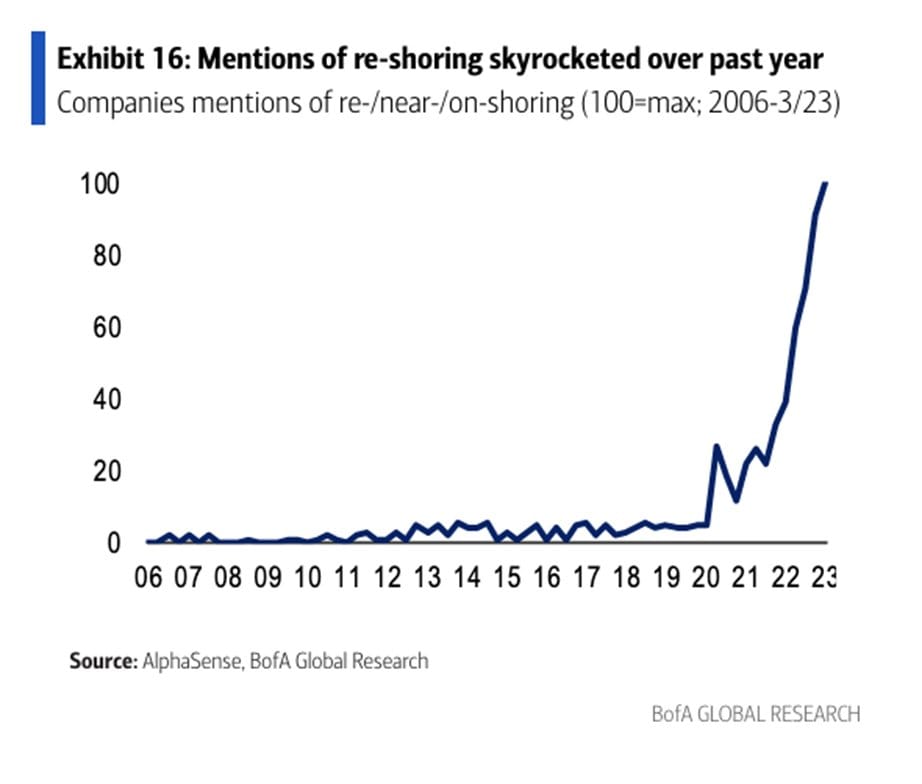
And its impact is far reaching.
Everything from the electric vehicle manufacturing to semiconductor production is headed back to America.
And there are two main reasons why…
The first is Covid.
As we all know, the pandemic brought the global economy to its knees.
Factories across the world shut down… producing huge bottlenecks in the global supply chain.
This led to shortages, and ultimately sky-high inflation.
In short, the pandemic revealed just how fragile the global supply chain can be when under stress.
Nobody wants to live through that again.
So, Corporate America and the U.S. government are taking massive measures to make sure that doesn’t happen again.
But Covid isn’t the only reason we’re seeing a huge surge in reshoring interest.
Tensions in the South China Sea have also kicked this megatrend into high gear.
Unless you’ve been living under a rock lately, you know that tensions between China and Taiwan are on the rise.
And that has huge implications for the rest of the world.
You see, Taiwan is a global semiconductor hub.
It produces 9 out of 10 high-end chips used worldwide. These are the kind that power your car, iPhone, smart TV, and even advanced weapons systems.
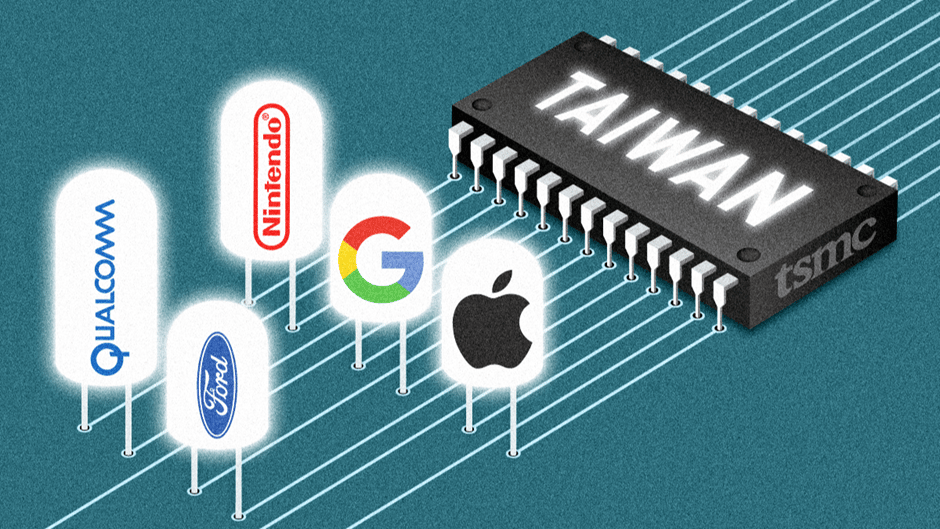
In short, the stakes are extremely high.
If China were to invade Taiwan, America could get cut off from this critical chip supply.
That simply can’t happen.
So, the Biden Administration is spending billions of dollars to ensure that more chips are made in America.
Last August, Biden signed the Bipartisan Infrastructure Law and the CHIPS Act & Inflation Reduction Act (IRA) into law.
Both laws earmarked billions of dollars for US manufacturing, particularly semiconductors.
The CHIPS Act alone included $39 billion for domestic production of semiconductors. Even more money was directed to research and development (R&D).
The response has been nothing short of amazing.
Chipmakers have since pledged $200B in investment, across 16 states.
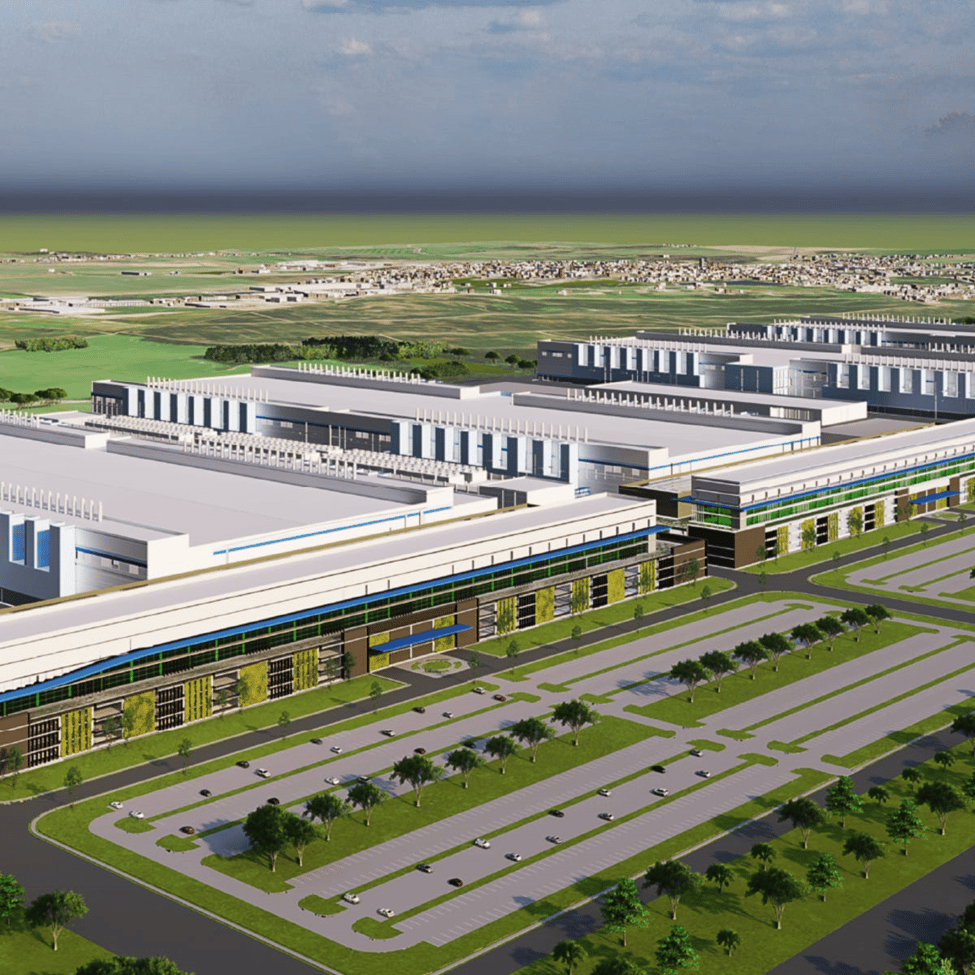
Perhaps most notably, Taiwan Semiconductor (TSM) - Taiwan’s largest semiconductor company - recently announced that it’s spending $40 billion to construct this state-of-the-art facility in Arizona.
This factory will start manufacturing 4-nm chips next year. By 2026, it will begin production of cutting-edge 3-nm chips.
In other words, some of the world’s most cutting-edge chips will soon be manufactured in the United States.
Taiwan Semiconductor isn’t alone.
Fellow chipmakers Intel (INTC), Texas Instruments (TXN), and Micron (MU) are also pouring billions of dollars into new US factories.
Micron, in particular, recently broke ground on a new manufacturing fab in Idaho. It was the company’s first new US manufacturing facility in two decades.
That’s just the beginning.
Micron also plans to invest as much as $100 billion over the next decade to build state-of-the-art memory manufacturing facilities in upstate New York.
The facility will be the largest U.S. semiconductor factory ever constructed. Upon completion, the facility will measure 40 football fields in size. It will also produce 50,000 jobs for the region.
Of course, reshoring is much, much bigger than just semiconductors.
Many other industries are also bringing their manufacturing back to America.
To accommodate this, America is going to need more factories… a lot more.
This April, factory construction accounted for 9.9% of all construction. That’s the highest portion since at least 1993.
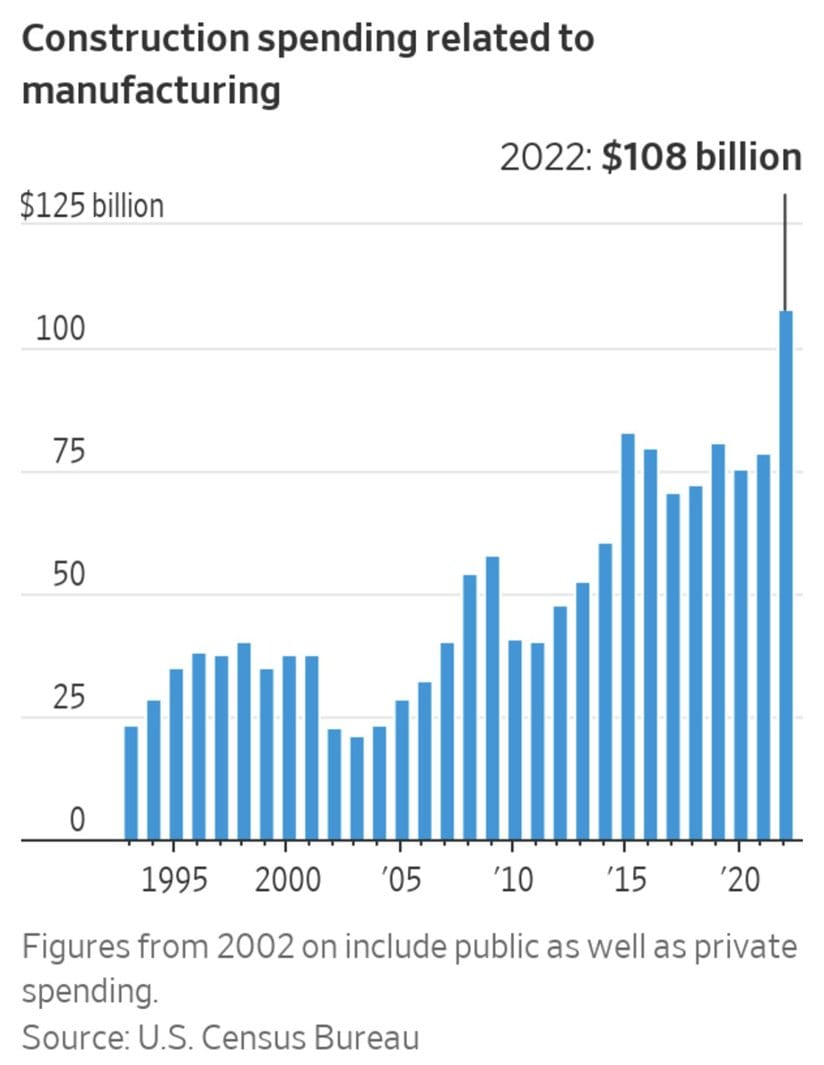
This tells us that reshoring isn’t talk. Massive amounts of money are already pouring into this megatrend.
And that means there’s big money for investors to make.
Three Ways to Cash in on the Reshoring Trend
DISCLAIMER: This is not financial advice. Follow us in our Telegram Channel for more real-time, actionable updates with technical analysis, until we release “The Discount Portfolio”.
Invest in semiconductors companies. Right now, most reshoring activity is focused on semiconductors… and for good reason.
Semis are the “brains” of the modern economy. They power everything from our smartphones to our cars. Without a steady supply of them, the U.S. economy would come crashing down.
That’s why we’re seeing so much money pour into the industry right now.
You can easily invest in semiconductors through an ETF like the VanEck Semiconductor ETF (SMH) or iShares Semiconductor ETF (SOXX).
Just understand that semi stocks have been on fire this year. So, look to buy corrections and with a long term outlook.
Invest in industrial companies.
Reshoring can’t happen without new factories, machinery, and infrastructure.
And that makes industrial stocks a great long-term bet. These companies are directly involved in the construction of new things.
The simplest way to invest in these stocks is through a fund like the The Industrial Sector ETF (XLI).
You could also pick up shares of the Global X U.S. Infrastructure Development ETF (PAVE), which invests in companies responsible for building out infrastructure needed to accommodate the reshoring boom.
Invest in robotics stocks. Let’s be real. American labor isn’t cheap.
To stay competitive during the reshoring boom, U.S. companies will need to be far more productive than other cheaper countries.
One of the best ways to do this is to invest in automation, specifically robotics.
You can easily invest bet on robots by buying Global X Robotics & Artificial Intelligence ETF (BOTZ) or Robo Global Robotics and Automation Index ETF (ROBO).
Both of these ETFs have been on a tear in 2023. So, we suggest looking to buy them on pullbacks and corrections with a long term outlook.
Follow us for much, much more… and in REAL-TIME.
We will be launching The Discount Portfolio soon. Here you can track all our long term, mid-term, and short-term trades in real-time, with common-sense analysis for each position we take.
A service that anyone, from beginner-to-advanced, can easily understand and take advantage of.
Be sure to subscribe via email, if you haven’t already, to receive the notification when our portfolio service launches.
For now, we already post our trades and analysis in real-time in our Telegram Channel.
We post every week on YouTube as well breaking down where markets are heading.
Stay tuned and have a great rest of your weekend.
See You Next Sunday!